Defining a macro to output the value of an expression : Macro Function « Macro Preprocessor « C / ANSI-C

C / ANSI-C
1. assert.h
2. Console
3. ctype.h
4. Data Structure Algorithm
5. Data Type
6. Development
7. File
8. Function
9. Language Basics
10. Macro Preprocessor
11. Math
12. math.h
13. Memory
14. Pointer
15. setjmp.h
16. signal.h
17. Small Application
18. stdio.h
19. stdlib.h
20. String
21. string.h
22. Structure
23. time.h
24. wctype.h
Microsoft Office Word 2007 Tutorial
Java
Java Tutorial
Java Source Code / Java Documentation
Java Open Source
Jar File Download
Java Articles
Java Products
Java by API
C# / C Sharp
C# / CSharp Tutorial
ASP.Net
JavaScript DHTML
JavaScript Tutorial
JavaScript Reference
HTML / CSS
HTML CSS Reference
C Tutorial
C++
C++ Tutorial
PHP
Python
SQL Server / T-SQL
Oracle PL / SQL
Oracle PL/SQL Tutorial
PostgreSQL
SQL / MySQL
MySQL Tutorial
VB.Net
VB.Net Tutorial
C / ANSI-C » Macro Preprocessor » Macro FunctionScreenshots 
Defining a macro to output the value of an expression
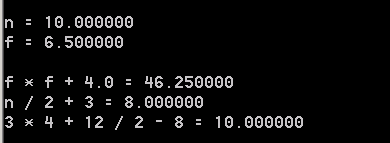

#include <stdio.h>

#define print_value(exprprintf("\n" #expr " = %lf"(double)expr);

void main() {
  int n = 10;
  double f = 6.5;

  print_value);
  print_value);
  printf("\n");

  print_value(f * f + 4.0);
  print_valuen / 3);
  print_value12 8);
  printf("\n");
}


Related examples in the same category
1. Defining a macro to compare two valuesDefining a macro to compare two values
2. Generate a square tableGenerate a square table
3. Define small function in macro
4. Make string
5. Use marco for small function
6. Use macro to find the minor variable
7. Define Macro as simple function
8. Use Macro to check the int range
9. Use Macro to get the bigger int value
ww_w._j___av_a___2___s___.___c___o__m | Contact Us
Copyright 2003 - 08 Demo Source and Support. All rights reserved.
All other trademarks are property of their respective owners.