Clipping
/*
Professional Windows GUI Programming Using C#
by Jay Glynn, Csaba Torok, Richard Conway, Wahid Choudhury,
   Zach Greenvoss, Shripad Kulkarni, Neil Whitlow

Publisher: Peer Information
ISBN: 1861007663
*/

using System;
using System.Drawing;
using System.Collections;
using System.ComponentModel;
using System.Windows.Forms;
using System.Data;

using System.Drawing.Drawing2D;

namespace Clipping
{
    /// <summary>
    /// Summary description for Clipping.
    /// </summary>
    public class Clipping : System.Windows.Forms.Form
    {
        /// <summary>
        /// Required designer variable.
        /// </summary>
        private System.ComponentModel.Container components = null;
        GraphicsPath gP;
        public Clipping()
        {
            //
            // Required for Windows Form Designer support
            //
            InitializeComponent();
            this.Text = "Transform and Clip";

            //
            // TODO: Add any constructor code after InitializeComponent call
            //
        }

        /// <summary>
        /// Clean up any resources being used.
        /// </summary>
        protected override void Dispose( bool disposing )
        {
            if( disposing )
            {
                if (components != null)
                {
                    components.Dispose();
                }
            }
            base.Dispose( disposing );
        }

        #region Windows Form Designer generated code
        /// <summary>
        /// Required method for Designer support - do not modify
        /// the contents of this method with the code editor.
        /// </summary>
        private void InitializeComponent()
        {
            //
            // Clipping
            //
            this.AutoScaleBaseSize = new System.Drawing.Size(5, 13);
            this.ClientSize = new System.Drawing.Size(292, 149);
            this.Name = "Clipping";
            this.Text = "Clipping";

        }
        #endregion

        /// <summary>
        /// The main entry point for the application.
        /// </summary>
        [STAThread]
        static void Main()
        {
            Application.Run(new Clipping());
        }
        protected override void OnPaint(System.Windows.Forms.PaintEventArgs e)
        {
            Graphics g = e.Graphics;
            DrawPathTransform(g);
            //DrawClip(g);
            g.Dispose();
        }
        void AddStringToPath(string s)
        {
            int fSt = (int)FontStyle.Regular;
            Point xy = new Point(50, 10);
            FontFamily fF = new FontFamily("Times new roman");
            StringFormat sFr = StringFormat.GenericDefault;

            gP.AddString(s, fF, fSt, 100, xy, sFr);  // add the string to the path
        }
        void DrawPathTransform(Graphics g)
        {
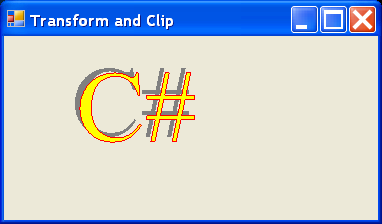
            gP = new GraphicsPath();  // create a new path
            AddStringToPath("C#");

            g.FillPath(Brushes.Gray, gP);  // draw the path to the surface
            Matrix m = new Matrix();
            m.Translate(5, 5);
            gP.Transform(m);
            g.FillPath(Brushes.Yellow, gP);  // draw the path to the surface
            g.DrawPath(Pens.Red, gP);  // draw the path to the surface
        }
        void DrawClip(Graphics g)
        {
            gP = new GraphicsPath();  // create a new path
            AddStringToPath("C#");

            g.SetClip(gP);
            g.TranslateClip(-5, -5);

            RectangleF rc = gP.GetBounds();
            rc.Offset(-5, -5);
            g.FillRectangle(Brushes.Gray, rc);  // results in gray C#

            g.ResetClip();
            g.FillPath(Brushes.Yellow, gP);  // draw the path to the surface
            g.DrawPath(Pens.Red, gP);  // draw the path to the surface
        }
    }
}
Related examples in the same category