Form Anchor
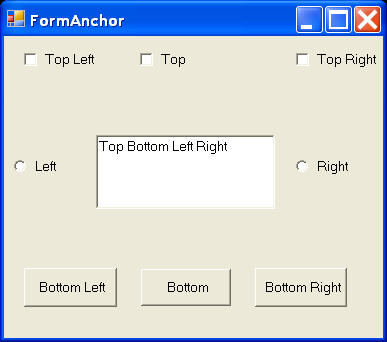
/*
C# Programming Tips & Techniques
by Charles Wright, Kris Jamsa

Publisher: Osborne/McGraw-Hill (December 28, 2001)
ISBN: 0072193794
*/

using System;
using System.Drawing;
using System.Collections;
using System.ComponentModel;
using System.Windows.Forms;
using System.Data;

namespace Anchor
{
  /// <summary>
  /// Summary description for Form1.
  /// </summary>
  public class FormAnchor : System.Windows.Forms.Form
  {
    private System.Windows.Forms.Button btnOK;
    private System.Windows.Forms.Button btnCancel;
    private System.Windows.Forms.TextBox textBox1;
    private System.Windows.Forms.Button btnClear;
    private System.Windows.Forms.CheckBox checkBox1;
    private System.Windows.Forms.CheckBox checkBox2;
    private System.Windows.Forms.CheckBox checkBox3;
    private System.Windows.Forms.RadioButton radioButton1;
    private System.Windows.Forms.RadioButton radioButton2;
    /// <summary>
    /// Required designer variable.
    /// </summary>
    private System.ComponentModel.Container components = null;

    public FormAnchor()
    {
      //
      // Required for Windows Form Designer support
      //
      InitializeComponent();

      //
      // TODO: Add any constructor code after InitializeComponent call
      //
    }

    /// <summary>
    /// Clean up any resources being used.
    /// </summary>
    protected override void Dispose( bool disposing )
    {
      if( disposing )
      {
        if (components != null)
        {
          components.Dispose();
        }
      }
      base.Dispose( disposing );
    }

    #region Windows Form Designer generated code
    /// <summary>
    /// Required method for Designer support - do not modify
    /// the contents of this method with the code editor.
    /// </summary>
    private void InitializeComponent()
    {
      this.btnOK = new System.Windows.Forms.Button();
      this.btnCancel = new System.Windows.Forms.Button();
      this.textBox1 = new System.Windows.Forms.TextBox();
      this.btnClear = new System.Windows.Forms.Button();
      this.checkBox1 = new System.Windows.Forms.CheckBox();
      this.checkBox2 = new System.Windows.Forms.CheckBox();
      this.checkBox3 = new System.Windows.Forms.CheckBox();
      this.radioButton1 = new System.Windows.Forms.RadioButton();
      this.radioButton2 = new System.Windows.Forms.RadioButton();
      this.SuspendLayout();
      //
      // btnOK
      //
      this.btnOK.Anchor = System.Windows.Forms.AnchorStyles.Bottom;
      this.btnOK.Location = new System.Drawing.Point(106, 188);
      this.btnOK.Name = "btnOK";
      this.btnOK.Size = new System.Drawing.Size(72, 32);
      this.btnOK.TabIndex = 0;
      this.btnOK.Text = "Bottom";
      //
      // btnCancel
      //
      this.btnCancel.Anchor = (System.Windows.Forms.AnchorStyles.Bottom | System.Windows.Forms.AnchorStyles.Right);
      this.btnCancel.Location = new System.Drawing.Point(196, 188);
      this.btnCancel.Name = "btnCancel";
      this.btnCancel.Size = new System.Drawing.Size(72, 32);
      this.btnCancel.TabIndex = 1;
      this.btnCancel.Text = "Bottom Right";
      //
      // textBox1
      //
      this.textBox1.Anchor = (((System.Windows.Forms.AnchorStyles.Top | System.Windows.Forms.AnchorStyles.Bottom)
        | System.Windows.Forms.AnchorStyles.Left)
        | System.Windows.Forms.AnchorStyles.Right);
      this.textBox1.Location = new System.Drawing.Point(72, 80);
      this.textBox1.Multiline = true;
      this.textBox1.Name = "textBox1";
      this.textBox1.Size = new System.Drawing.Size(140, 60);
      this.textBox1.TabIndex = 2;
      this.textBox1.Text = "Top Bottom Left Right";
      //
      // btnClear
      //
      this.btnClear.Anchor = (System.Windows.Forms.AnchorStyles.Bottom | System.Windows.Forms.AnchorStyles.Left);
      this.btnClear.Location = new System.Drawing.Point(16, 188);
      this.btnClear.Name = "btnClear";
      this.btnClear.Size = new System.Drawing.Size(72, 32);
      this.btnClear.TabIndex = 3;
      this.btnClear.Text = "Bottom Left";
      //
      // checkBox1
      //
      this.checkBox1.Location = new System.Drawing.Point(16, 8);
      this.checkBox1.Name = "checkBox1";
      this.checkBox1.Size = new System.Drawing.Size(56, 24);
      this.checkBox1.TabIndex = 4;
      this.checkBox1.Text = "Top Left";
      //
      // checkBox2
      //
      this.checkBox2.Anchor = (System.Windows.Forms.AnchorStyles.Top | System.Windows.Forms.AnchorStyles.Right);
      this.checkBox2.Location = new System.Drawing.Point(228, 8);
      this.checkBox2.Name = "checkBox2";
      this.checkBox2.Size = new System.Drawing.Size(64, 24);
      this.checkBox2.TabIndex = 5;
      this.checkBox2.Text = "Top Right";
      //
      // checkBox3
      //
      this.checkBox3.Anchor = System.Windows.Forms.AnchorStyles.Top;
      this.checkBox3.Location = new System.Drawing.Point(106, 8);
      this.checkBox3.Name = "checkBox3";
      this.checkBox3.Size = new System.Drawing.Size(80, 24);
      this.checkBox3.TabIndex = 6;
      this.checkBox3.Text = "Top";
      //
      // radioButton1
      //
      this.radioButton1.Anchor = System.Windows.Forms.AnchorStyles.Left;
      this.radioButton1.Location = new System.Drawing.Point(8, 82);
      this.radioButton1.Name = "radioButton1";
      this.radioButton1.Size = new System.Drawing.Size(48, 48);
      this.radioButton1.TabIndex = 7;
      this.radioButton1.Text = "Left";
      //
      // radioButton2
      //
      this.radioButton2.Anchor = System.Windows.Forms.AnchorStyles.Right;
      this.radioButton2.Location = new System.Drawing.Point(228, 82);
      this.radioButton2.Name = "radioButton2";
      this.radioButton2.Size = new System.Drawing.Size(56, 48);
      this.radioButton2.TabIndex = 8;
      this.radioButton2.Text = "Right";
      //
      // FormAnchor
      //
      this.AutoScaleBaseSize = new System.Drawing.Size(5, 13);
      this.ClientSize = new System.Drawing.Size(296, 245);
      this.Controls.AddRange(new System.Windows.Forms.Control[] {
                                      this.radioButton2,
                                      this.radioButton1,
                                      this.checkBox3,
                                      this.checkBox2,
                                      this.checkBox1,
                                      this.btnClear,
                                      this.textBox1,
                                      this.btnCancel,
                                      this.btnOK});
      this.Name = "FormAnchor";
      this.Text = "FormAnchor";
      this.ResumeLayout(false);

    }
    #endregion

    /// <summary>
    /// The main entry point for the application.
    /// </summary>
    [STAThread]
    static void Main()
    {
      Application.Run(new FormAnchor());
    }
  }
}
Related examples in the same category