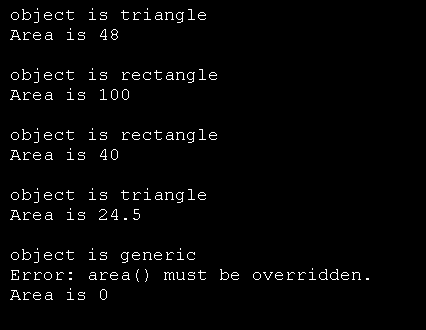
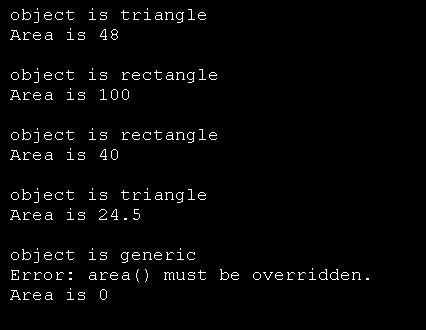
Object array: polymorphism.
#include <iostream>
#include <cstring>
using namespace std;

class TwoDimensionShape {
  double width;
  double height;
  char name[20];
public:

  TwoDimensionShape() {
    width = height = 0.0;
    strcpy(name, "unknown");
  }

  TwoDimensionShape(double w, double h, char *n) {
    width = w;
    height = h;
    strcpy(name, n);
  }

  TwoDimensionShape(double x, char *n) {
    width = height = x;
    strcpy(name, n);
  }

  void showDim() {
    cout << "Width and height are " << width << " and " << height << endl;
  }

  double getWidth() {
     return width;
  }
  double getHeight() {
     return height;
  }
  void setWidth(double w) {
     width = w;
  }
  void setHeight(double h) {
     height = h;
  }
  char *getName() {
     return name;
  }

  virtual double area() {
    cout << "Error: area() must be overridden.\n";
    return 0.0;
  }

};

class Triangle : public TwoDimensionShape {
  char style[20]; // now private
public:

  Triangle() {
    strcpy(style, "unknown");
  }

  Triangle(char *str, double w,
           double h) : TwoDimensionShape(w, h, "triangle") {
    strcpy(style, str);
  }

  Triangle(double x) : TwoDimensionShape(x, "triangle") {
    strcpy(style, "isosceles");
  }

  double area() {
    return getWidth() * getHeight() / 2;
  }

  void showStyle() {
    cout << "Triangle is " << style << endl;
  }
};

class Rectangle : public TwoDimensionShape {
public:


  Rectangle(double w, double h) : TwoDimensionShape(w, h, "rectangle") { }


  Rectangle(double x) :
    TwoDimensionShape(x, "rectangle") { }

  bool isSquare() {
    if(getWidth() == getHeight())
       return true;
    return false;
  }

  // This is another override of area().
  double area() {
    return getWidth() * getHeight();
  }
};

int main() {

  TwoDimensionShape *shapes[5];

  shapes[0] = &Triangle("right", 8.0, 12.0);
  shapes[1] = &Rectangle(10);
  shapes[2] = &Rectangle(10, 4);
  shapes[3] = &Triangle(7.0);
  shapes[4] = &TwoDimensionShape(10, 20, "generic");

  for(int i = 0; i < 5; i++) {
    cout << "object is " << shapes[i]->getName() << endl;

    cout << "Area is " << shapes[i]->area() << endl;

    cout << endl;
  }

  return 0;
}
Related examples in the same category