Your own Queue class : Queue « Data Structure « C++

C++
1. Bitset
2. Class
3. Console
4. Data Structure
5. Data Type
6. Deque
7. Development
8. File
9. Function
10. Generic
11. Language
12. List
13. Map Multimap
14. Overload
15. Pointer
16. Queue Stack
17. Set Multiset
18. STL Algorithms Binary search
19. STL Algorithms Heap
20. STL Algorithms Helper
21. STL Algorithms Iterator
22. STL Algorithms Merge
23. STL Algorithms Min Max
24. STL Algorithms Modifying sequence operations
25. STL Algorithms Non modifying sequence operations
26. STL Algorithms Sorting
27. STL Basics
28. String
29. Valarray
30. Vector
Java
Java Tutorial
Java Source Code / Java Documentation
Java Open Source
Jar File Download
Java Articles
Java Products
Java by API
C# / C Sharp
C# / CSharp Tutorial
ASP.Net
JavaScript DHTML
JavaScript Tutorial
JavaScript Reference
HTML / CSS
HTML CSS Reference
C / ANSI-C
C Tutorial
C++ Tutorial
PHP
Python
SQL Server / T-SQL
SQL Server / T-SQL Tutorial
Oracle PL / SQL
Oracle PL/SQL Tutorial
PostgreSQL
SQL / MySQL
MySQL Tutorial
VB.Net
VB.Net Tutorial
Flash / Flex / ActionScript
VBA / Excel / Access / Word
Microsoft Office PowerPoint 2007 Tutorial
Microsoft Office Excel 2007 Tutorial
Microsoft Office Word 2007 Tutorial
C++ » Data Structure » QueueScreenshots 
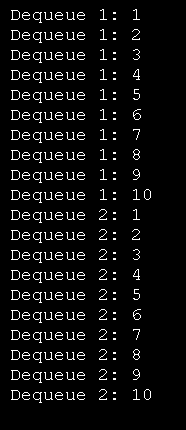
Your own Queue class


#include <iostream>
using namespace std;

#define SIZE 100

class QueueClass {
  int queue[SIZE]
  int head, tail; 
public:
  QueueClass()
  void q(int num)
  int deq();  
};

QueueClass::QueueClass()
{
  head = tail = 0;
}

void QueueClass::q(int num)
{
  if(tail+1==head || (tail+1==SIZE && !head)) {
    cout << "Queue is full\n";
    return;
  }
  tail++;
  if(tail==SIZEtail = 0// cycle around
  queue[tail= num;
}

int QueueClass::deq()
{
  if(head == tail) {
    cout << "Queue is empty\n";
    return 0;                    // or some other error indicator
  }
  head++;
  if(head==SIZEhead = 0;       // cycle around
  return queue[head];
}

int main()
{
  QueueClass queue1, queue2;
  int i;

  for(i=1; i <=10; i++) {
    queue1.q(i);
  }

  queue2 = queue1;

  for(i=1; i <=10; i++
    cout << "Dequeue 1: " << queue1.deq() << endl;

  for(i=1; i <=10; i++
    cout << "Dequeue 2: " << queue2.deq() << endl;

  return 0;
}


Related examples in the same category
1. Queue: push and popQueue: push and pop
2. Demonstrate the queue class: push, front, empty and popDemonstrate the queue class: push, front, empty and pop
3. Cycling through a queue.Cycling through a queue.
4. Define our own Queue classDefine our own Queue class
5. Define a queueDefine a queue
w_w__w___.___ja_v_a2_s__.c___om__ | Contact Us
Copyright 2003 - 08 Demo Source and Support. All rights reserved.
All other trademarks are property of their respective owners.