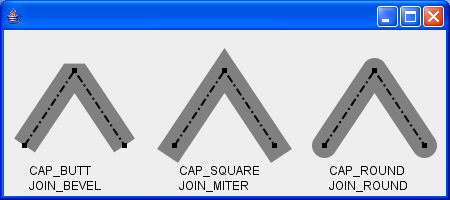
Line Styles
/*
 * Copyright (c) 2000 David Flanagan.  All rights reserved.
 * This code is from the book Java Examples in a Nutshell, 2nd Edition.
 * It is provided AS-IS, WITHOUT ANY WARRANTY either expressed or implied.
 * You may study, use, and modify it for any non-commercial purpose.
 * You may distribute it non-commercially as long as you retain this notice.
 * For a commercial use license, or to purchase the book (recommended),
 * visit http://www.davidflanagan.com/javaexamples2.
 */
import java.awt.BasicStroke;
import java.awt.Color;
import java.awt.Font;
import java.awt.Graphics;
import java.awt.Graphics2D;
import java.awt.RenderingHints;
import java.awt.Stroke;
import java.awt.event.WindowAdapter;
import java.awt.event.WindowEvent;
import java.awt.geom.GeneralPath;

import javax.swing.JFrame;
import javax.swing.JPanel;

/** A demonstration of Java2D line styles */
public class LineStyles extends JPanel{
  public String getName() {
    return "LineStyles";
  }

  public int getWidth() {
    return 450;
  }

  public int getHeight() {
    return 180;
  }

  int[] xpoints = new int[] { 0, 50, 100 }; // X coordinates of our shape

  int[] ypoints = new int[] { 75, 0, 75 }; // Y coordinates of our shape

  // Here are three different line styles we will demonstrate
  // They are thick lines with different cap and join styles
  Stroke[] linestyles = new Stroke[] {
      new BasicStroke(25.0f, BasicStroke.CAP_BUTT, BasicStroke.JOIN_BEVEL),
      new BasicStroke(25.0f, BasicStroke.CAP_SQUARE,
          BasicStroke.JOIN_MITER),
      new BasicStroke(25.0f, BasicStroke.CAP_ROUND,
          BasicStroke.JOIN_ROUND), };

  // Another line style: a 2 pixel-wide dot-dashed line
  Stroke thindashed = new BasicStroke(2.0f, // line width
      /* cap style */BasicStroke.CAP_BUTT,
      /* join style, miter limit */BasicStroke.JOIN_BEVEL, 1.0f,
      /* the dash pattern */new float[] { 8.0f, 3.0f, 2.0f, 3.0f },
      /* the dash phase */0.0f); /* on 8, off 3, on 2, off 3 */

  // Labels to appear in the diagram, and the font to use to display them.
  Font font = new Font("Helvetica", Font.BOLD, 12);

  String[] capNames = new String[] { "CAP_BUTT", "CAP_SQUARE", "CAP_ROUND" };

  String[] joinNames = new String[] { "JOIN_BEVEL", "JOIN_MITER",
      "JOIN_ROUND" };

  /** This method draws the example figure */
  public void paint(Graphics g1) {
    Graphics2D g = (Graphics2D) g1;
    // Use anti-aliasing to avoid "jaggies" in the lines
    g.setRenderingHint(RenderingHints.KEY_ANTIALIASING,
        RenderingHints.VALUE_ANTIALIAS_ON);

    // Define the shape to draw
    GeneralPath shape = new GeneralPath();
    shape.moveTo(xpoints[0], ypoints[0]); // start at point 0
    shape.lineTo(xpoints[1], ypoints[1]); // draw a line to point 1
    shape.lineTo(xpoints[2], ypoints[2]); // and then on to point 2

    // Move the origin to the right and down, creating a margin
    g.translate(20, 40);

    // Now loop, drawing our shape with the three different line styles
    for (int i = 0; i < linestyles.length; i++) {
      g.setColor(Color.gray); // Draw a gray line
      g.setStroke(linestyles[i]); // Select the line style to use
      g.draw(shape); // Draw the shape

      g.setColor(Color.black); // Now use black
      g.setStroke(thindashed); // And the thin dashed line
      g.draw(shape); // And draw the shape again.

      // Highlight the location of the vertexes of the shape
      // This accentuates the cap and join styles we're demonstrating
      for (int j = 0; j < xpoints.length; j++)
        g.fillRect(xpoints[j] - 2, ypoints[j] - 2, 5, 5);

      g.drawString(capNames[i], 5, 105); // Label the cap style
      g.drawString(joinNames[i], 5, 120); // Label the join style

      g.translate(150, 0); // Move over to the right before looping again
    }
  }
  public static void main(String[] a){
      JFrame f = new JFrame();
      f.addWindowListener(new WindowAdapter() {
      public void windowClosing(WindowEvent e) {
        System.exit(0);
      }
    });
      f.setContentPane(new LineStyles());
      f.setSize(450,200);
      f.setVisible(true);
  }
}
Related examples in the same category