ADO.NET Binding : Multiple Control Binding
/*
User Interfaces in C#: Windows Forms and Custom Controls
by Matthew MacDonald

Publisher: Apress
ISBN: 1590590457
*/

using System;
using System.Drawing;
using System.Collections;
using System.ComponentModel;
using System.Windows.Forms;
using System.Data;

namespace ADO.NET_Binding
{
    /// <summary>
    /// Summary description for MultipleControlBinding.
    /// </summary>
    public class MultipleControlBinding : System.Windows.Forms.Form
    {
        internal System.Windows.Forms.GroupBox GroupBox1;
        internal System.Windows.Forms.Label lblDescription;
        internal System.Windows.Forms.Label lblUnitCost;
        internal System.Windows.Forms.Label lblModelNumber;
        internal System.Windows.Forms.Button cmdNext;
        internal System.Windows.Forms.Button cmdPrev;
        internal System.Windows.Forms.ComboBox cboModelName;
        /// <summary>
        /// Required designer variable.
        /// </summary>
        private System.ComponentModel.Container components = null;

        public MultipleControlBinding()
        {
            //
            // Required for Windows Form Designer support
            //
            InitializeComponent();

            //
            // TODO: Add any constructor code after InitializeComponent call
            //
        }

        /// <summary>
        /// Clean up any resources being used.
        /// </summary>
        protected override void Dispose( bool disposing )
        {
            if( disposing )
            {
                if(components != null)
                {
                    components.Dispose();
                }
            }
            base.Dispose( disposing );
        }

        #region Windows Form Designer generated code
        /// <summary>
        /// Required method for Designer support - do not modify
        /// the contents of this method with the code editor.
        /// </summary>
        private void InitializeComponent()
        {
            this.GroupBox1 = new System.Windows.Forms.GroupBox();
            this.lblDescription = new System.Windows.Forms.Label();
            this.lblUnitCost = new System.Windows.Forms.Label();
            this.lblModelNumber = new System.Windows.Forms.Label();
            this.cmdNext = new System.Windows.Forms.Button();
            this.cmdPrev = new System.Windows.Forms.Button();
            this.cboModelName = new System.Windows.Forms.ComboBox();
            this.GroupBox1.SuspendLayout();
            this.SuspendLayout();
            //
            // GroupBox1
            //
            this.GroupBox1.Anchor = (((System.Windows.Forms.AnchorStyles.Top | System.Windows.Forms.AnchorStyles.Bottom)
                | System.Windows.Forms.AnchorStyles.Left)
                | System.Windows.Forms.AnchorStyles.Right);
            this.GroupBox1.Controls.AddRange(new System.Windows.Forms.Control[] {
                                                                                    this.lblDescription,
                                                                                    this.lblUnitCost,
                                                                                    this.lblModelNumber});
            this.GroupBox1.FlatStyle = System.Windows.Forms.FlatStyle.System;
            this.GroupBox1.Location = new System.Drawing.Point(18, 47);
            this.GroupBox1.Name = "GroupBox1";
            this.GroupBox1.Size = new System.Drawing.Size(312, 168);
            this.GroupBox1.TabIndex = 10;
            this.GroupBox1.TabStop = false;
            //
            // lblDescription
            //
            this.lblDescription.Anchor = (((System.Windows.Forms.AnchorStyles.Top | System.Windows.Forms.AnchorStyles.Bottom)
                | System.Windows.Forms.AnchorStyles.Left)
                | System.Windows.Forms.AnchorStyles.Right);
            this.lblDescription.Location = new System.Drawing.Point(8, 58);
            this.lblDescription.Name = "lblDescription";
            this.lblDescription.Size = new System.Drawing.Size(296, 98);
            this.lblDescription.TabIndex = 6;
            //
            // lblUnitCost
            //
            this.lblUnitCost.Location = new System.Drawing.Point(168, 16);
            this.lblUnitCost.Name = "lblUnitCost";
            this.lblUnitCost.Size = new System.Drawing.Size(136, 32);
            this.lblUnitCost.TabIndex = 5;
            //
            // lblModelNumber
            //
            this.lblModelNumber.Location = new System.Drawing.Point(8, 16);
            this.lblModelNumber.Name = "lblModelNumber";
            this.lblModelNumber.Size = new System.Drawing.Size(140, 32);
            this.lblModelNumber.TabIndex = 4;
            //
            // cmdNext
            //
            this.cmdNext.Anchor = (System.Windows.Forms.AnchorStyles.Bottom | System.Windows.Forms.AnchorStyles.Right);
            this.cmdNext.FlatStyle = System.Windows.Forms.FlatStyle.System;
            this.cmdNext.Location = new System.Drawing.Point(238, 227);
            this.cmdNext.Name = "cmdNext";
            this.cmdNext.Size = new System.Drawing.Size(92, 28);
            this.cmdNext.TabIndex = 9;
            this.cmdNext.Text = "Next >>";
            this.cmdNext.Click += new System.EventHandler(this.cmdNext_Click);
            //
            // cmdPrev
            //
            this.cmdPrev.Anchor = (System.Windows.Forms.AnchorStyles.Bottom | System.Windows.Forms.AnchorStyles.Left);
            this.cmdPrev.Enabled = false;
            this.cmdPrev.FlatStyle = System.Windows.Forms.FlatStyle.System;
            this.cmdPrev.Location = new System.Drawing.Point(18, 227);
            this.cmdPrev.Name = "cmdPrev";
            this.cmdPrev.Size = new System.Drawing.Size(92, 28);
            this.cmdPrev.TabIndex = 8;
            this.cmdPrev.Text = "<< Prev";
            this.cmdPrev.Click += new System.EventHandler(this.cmdPrev_Click);
            //
            // cboModelName
            //
            this.cboModelName.DropDownStyle = System.Windows.Forms.ComboBoxStyle.DropDownList;
            this.cboModelName.Location = new System.Drawing.Point(14, 11);
            this.cboModelName.Name = "cboModelName";
            this.cboModelName.Size = new System.Drawing.Size(316, 21);
            this.cboModelName.TabIndex = 7;
            //
            // MultipleControlBinding
            //
            this.AutoScaleBaseSize = new System.Drawing.Size(5, 13);
            this.ClientSize = new System.Drawing.Size(344, 266);
            this.Controls.AddRange(new System.Windows.Forms.Control[] {
                                                                          this.GroupBox1,
                                                                          this.cmdNext,
                                                                          this.cmdPrev,
                                                                          this.cboModelName});
            this.Name = "MultipleControlBinding";
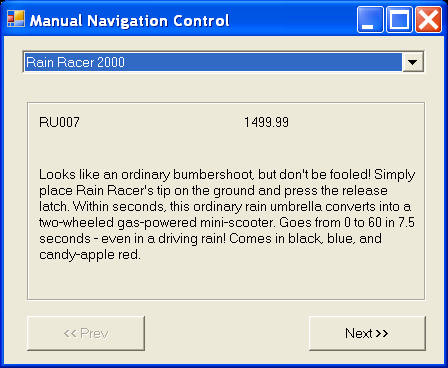
            this.Text = "Manual Navigation Control";
            this.Load += new System.EventHandler(this.MultipleControlBinding_Load);
            this.GroupBox1.ResumeLayout(false);
            this.ResumeLayout(false);

        }
        #endregion


        private BindingManagerBase storeBinding;

        private void MultipleControlBinding_Load(object sender, System.EventArgs e)
        {
            DataSet dsStore = new DataSet();

            dsStore.ReadXmlSchema(Application.StartupPath + "\\store.xsd");
            dsStore.ReadXml(Application.StartupPath + "\\store.xml");

            cboModelName.DataSource = dsStore.Tables["Products"];
            cboModelName.DisplayMember = "ModelName";

            lblModelNumber.DataBindings.Add("Text",
                dsStore.Tables["Products"], "ModelNumber");
            lblUnitCost.DataBindings.Add("Text",
                dsStore.Tables["Products"], "UnitCost");
            lblDescription.DataBindings.Add("Text",
                dsStore.Tables["Products"], "Description");

            storeBinding = this.BindingContext[dsStore.Tables["Products"]];
            storeBinding.PositionChanged += new EventHandler(Binding_PositionChanged);
        }

        [STAThread]
        static void Main()
        {
            Application.Run(new MultipleControlBinding());
        }

        private void cmdNext_Click(object sender, System.EventArgs e)
        {
                storeBinding.Position++;
        }

        private void cmdPrev_Click(object sender, System.EventArgs e)
        {
                storeBinding.Position--;
        }

        private void Binding_PositionChanged(object sender, System.EventArgs e)
        {
            if (storeBinding.Position == storeBinding.Count - 1)
            {
                cmdNext.Enabled = false;
            }
            else
            {
                cmdNext.Enabled = true;
            }

            if (storeBinding.Position == 0)
            {
                cmdPrev.Enabled = false;
            }
            else
            {
                cmdPrev.Enabled = true;
            }
        }

    }
}
 ADO.NETBinding.zip( 76 k)
Related examples in the same category