Data Binding 3 : Data Binding « Database ADO.net « C# / C Sharp
Data Binding 3
/*
Professional Windows GUI Programming Using C#
by Jay Glynn, Csaba Torok, Richard Conway, Wahid Choudhury,
   Zach Greenvoss, Shripad Kulkarni, Neil Whitlow

Publisher: Peer Information
ISBN: 1861007663
*/

using System;
using System.Drawing;
using System.Collections;
using System.ComponentModel;
using System.Windows.Forms;
using System.Data;
using System.Data.SqlClient;

namespace DataBinding_3
{
    /// <summary>
    /// Summary description for DataBinding_3.
    /// </summary>
    public class DataBinding_3 : System.Windows.Forms.Form
    {
        private System.Windows.Forms.DataGrid grdOrders;
        private System.Windows.Forms.DataGrid grdOrderDetails;
        private System.Windows.Forms.DataGrid grdCustomers;
        /// <summary>
        /// Required designer variable.
        /// </summary>
        private System.ComponentModel.Container components = null;

        public DataBinding_3()
        {
            //
            // Required for Windows Form Designer support
            //
            InitializeComponent();

            //
            // TODO: Add any constructor code after InitializeComponent call
            //

            SqlConnection cn=new SqlConnection(@"data source=(local);uid=sa;password=;database=northwind");

            DataSet ds = new DataSet("CustOrders");

            SqlDataAdapter daCust=new SqlDataAdapter("select * from customers;select * from orders;select * from [order details]",cn);
            daCust.Fill(ds);

            ds.Relations.Add("CustOrder",ds.Tables["Table"].Columns["customerid"],ds.Tables["Table1"].Columns["customerid"]);
            ds.Relations.Add("OrderDetail",ds.Tables["Table1"].Columns["orderid"],ds.Tables["Table2"].Columns["orderid"]);

            grdCustomers.DataSource=ds;
            grdCustomers.DataMember="Table";
            grdOrders.DataSource=ds;
            grdOrders.DataMember="Table.CustOrder";
            grdOrderDetails.DataSource=ds;
            grdOrderDetails.DataMember="Table.CustOrder.OrderDetail";
        }

        /// <summary>
        /// Clean up any resources being used.
        /// </summary>
        protected override void Dispose( bool disposing )
        {
            if( disposing )
            {
                if (components != null)
                {
                    components.Dispose();
                }
            }
            base.Dispose( disposing );
        }

        #region Windows Form Designer generated code
        /// <summary>
        /// Required method for Designer support - do not modify
        /// the contents of this method with the code editor.
        /// </summary>
        private void InitializeComponent()
        {
            this.grdCustomers = new System.Windows.Forms.DataGrid();
            this.grdOrders = new System.Windows.Forms.DataGrid();
            this.grdOrderDetails = new System.Windows.Forms.DataGrid();
            ((System.ComponentModel.ISupportInitialize)(this.grdCustomers)).BeginInit();
            ((System.ComponentModel.ISupportInitialize)(this.grdOrders)).BeginInit();
            ((System.ComponentModel.ISupportInitialize)(this.grdOrderDetails)).BeginInit();
            this.SuspendLayout();
            //
            // grdCustomers
            //
            this.grdCustomers.AllowNavigation = false;
            this.grdCustomers.DataMember = "";
            this.grdCustomers.HeaderForeColor = System.Drawing.SystemColors.ControlText;
            this.grdCustomers.Location = new System.Drawing.Point(40, 16);
            this.grdCustomers.Name = "grdCustomers";
            this.grdCustomers.Size = new System.Drawing.Size(448, 152);
            this.grdCustomers.TabIndex = 0;
            //
            // grdOrders
            //
            this.grdOrders.AllowNavigation = false;
            this.grdOrders.DataMember = "";
            this.grdOrders.HeaderForeColor = System.Drawing.SystemColors.ControlText;
            this.grdOrders.Location = new System.Drawing.Point(40, 176);
            this.grdOrders.Name = "grdOrders";
            this.grdOrders.Size = new System.Drawing.Size(448, 144);
            this.grdOrders.TabIndex = 1;
            //
            // grdOrderDetails
            //
            this.grdOrderDetails.DataMember = "";
            this.grdOrderDetails.HeaderForeColor = System.Drawing.SystemColors.ControlText;
            this.grdOrderDetails.Location = new System.Drawing.Point(40, 328);
            this.grdOrderDetails.Name = "grdOrderDetails";
            this.grdOrderDetails.Size = new System.Drawing.Size(448, 136);
            this.grdOrderDetails.TabIndex = 2;
            //
            // DataBinding_3
            //
            this.AutoScaleBaseSize = new System.Drawing.Size(5, 13);
            this.ClientSize = new System.Drawing.Size(528, 483);
            this.Controls.AddRange(new System.Windows.Forms.Control[] {
                                                                  this.grdOrderDetails,
                                                                  this.grdOrders,
                                                                  this.grdCustomers});
            this.Name = "DataBinding_3";
            this.Text = "DataBinding_3";
            ((System.ComponentModel.ISupportInitialize)(this.grdCustomers)).EndInit();
            ((System.ComponentModel.ISupportInitialize)(this.grdOrders)).EndInit();
            ((System.ComponentModel.ISupportInitialize)(this.grdOrderDetails)).EndInit();
            this.ResumeLayout(false);

        }
        #endregion

        /// <summary>
        /// The main entry point for the application.
        /// </summary>
        [STAThread]
        static void Main()
        {
            Application.Run(new DataBinding_3());
        }
    }
}
Related examples in the same category
| 1. | ADO.NET Binding: Handling Errors |  | 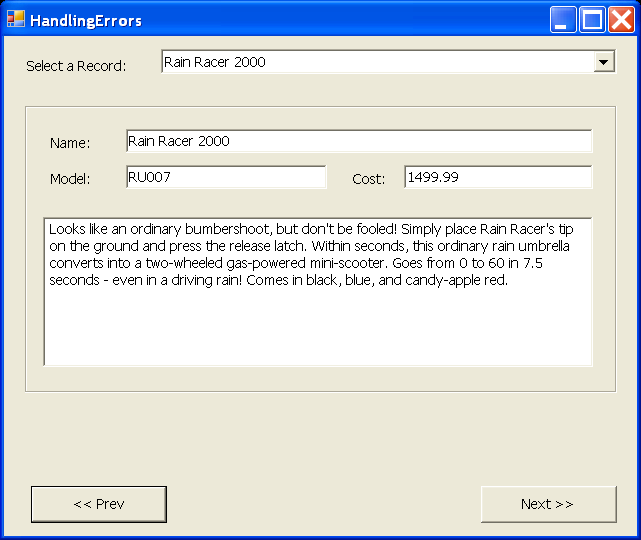 |
| 2. | ADO.NET Binding: Master Detail | | 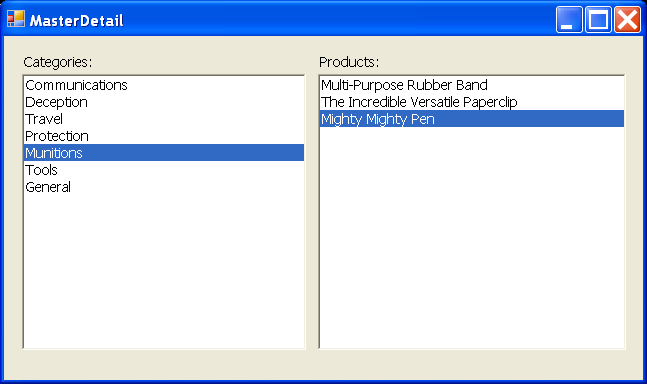 |
| 3. | ADO.NET Binding : Multiple Control Binding | | 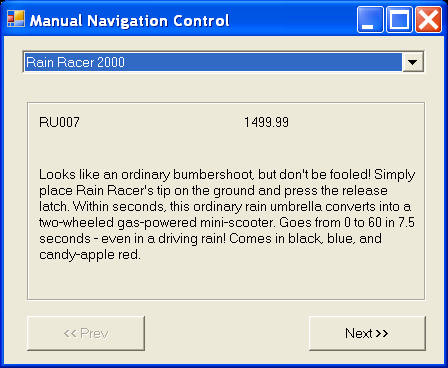 |
| 4. | ADO.NET Binding : Unsynchronized | | 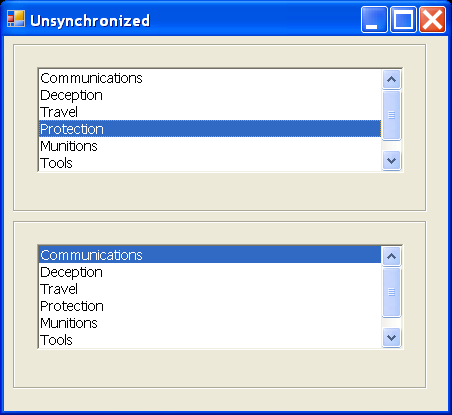 |
| 5. | Data Binding 4 |