Change the background and text colors of a form using Color Dialog
using System;
using System.Drawing;
using System.Collections;
using System.ComponentModel;
using System.Windows.Forms;
using System.Data;


   public class ShowColorsComplex : System.Windows.Forms.Form
   {
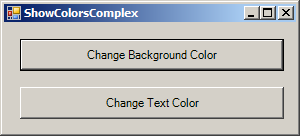
      private System.Windows.Forms.Button backgroundColorButton;
      private System.Windows.Forms.Button textColorButton;

      public ShowColorsComplex()
      {
         InitializeComponent();
      }

      private void InitializeComponent()
      {
         this.backgroundColorButton = new System.Windows.Forms.Button();
         this.textColorButton = new System.Windows.Forms.Button();
         this.SuspendLayout();
         //
         // backgroundColorButton
         //
         this.backgroundColorButton.Location = new System.Drawing.Point(16, 16);
         this.backgroundColorButton.Name = "backgroundColorButton";
         this.backgroundColorButton.Size = new System.Drawing.Size(264, 32);
         this.backgroundColorButton.TabIndex = 0;
         this.backgroundColorButton.Text = "Change Background Color";
         this.backgroundColorButton.Click += new System.EventHandler(this.backgroundColorButton_Click);
         //
         // textColorButton
         //
         this.textColorButton.Location = new System.Drawing.Point(16, 64);
         this.textColorButton.Name = "textColorButton";
         this.textColorButton.Size = new System.Drawing.Size(264, 32);
         this.textColorButton.TabIndex = 1;
         this.textColorButton.Text = "Change Text Color";
         this.textColorButton.Click += new System.EventHandler(this.textColorButton_Click);
         //
         // ShowColorsComplex
         //
         this.AutoScaleBaseSize = new System.Drawing.Size(5, 13);
         this.ClientSize = new System.Drawing.Size(292, 109);
         this.Controls.AddRange(new System.Windows.Forms.Control[] {
                                                                      this.textColorButton,
                                                                      this.backgroundColorButton});
         this.Name = "ShowColorsComplex";
         this.Text = "ShowColorsComplex";
         this.ResumeLayout(false);

      }
      static void Main()
      {
         Application.Run( new ShowColorsComplex() );
      }

      private void textColorButton_Click(object sender, System.EventArgs e ){
         ColorDialog colorChooser = new ColorDialog();
         DialogResult result;

         result = colorChooser.ShowDialog();

         if ( result == DialogResult.Cancel )
            return;

         backgroundColorButton.ForeColor = colorChooser.Color;
         textColorButton.ForeColor = colorChooser.Color;

      }
      private void backgroundColorButton_Click(object sender, System.EventArgs e ){
         ColorDialog colorChooser = new ColorDialog();
         DialogResult result;

         colorChooser.FullOpen = true;
         result = colorChooser.ShowDialog();

         if ( result == DialogResult.Cancel )
            return;
         this.BackColor = colorChooser.Color;
      }
   }
Related examples in the same category