illustrates the use of a System.Exception object : Exception Class « Language Basics « C# / C Sharp

C# / C Sharp
1. 2D Graphics
2. Class Interface
3. Collections Data Structure
4. Components
5. Data Types
6. Database ADO.net
7. Design Patterns
8. Development Class
9. Event
10. File Stream
11. Generics
12. GUI Windows Form
13. Language Basics
14. LINQ
15. Network
16. Office
17. Reflection
18. Regular Expressions
19. Security
20. Services Event
21. Thread
22. Web Services
23. Windows
24. XML
25. XML LINQ
Java
Java Tutorial
Java Source Code / Java Documentation
Java Open Source
Jar File Download
Java Articles
Java Products
Java by API
C# / CSharp Tutorial
ASP.Net
JavaScript DHTML
JavaScript Tutorial
JavaScript Reference
HTML / CSS
HTML CSS Reference
C / ANSI-C
C Tutorial
C++
C++ Tutorial
PHP
Python
SQL Server / T-SQL
Oracle PL / SQL
Oracle PL/SQL Tutorial
PostgreSQL
SQL / MySQL
MySQL Tutorial
VB.Net
VB.Net Tutorial
Flash / Flex / ActionScript
VBA / Excel / Access / Word
Microsoft Office PowerPoint 2007 Tutorial
Microsoft Office Excel 2007 Tutorial
Microsoft Office Word 2007 Tutorial
C# / C Sharp » Language Basics » Exception ClassScreenshots 
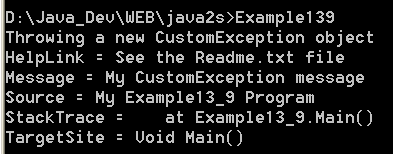
illustrates the use of a System.Exception object
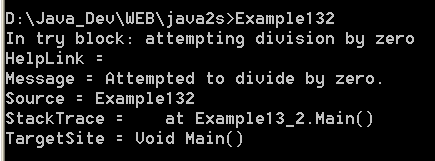

/*
Mastering Visual C# .NET
by Jason Price, Mike Gunderloy

Publisher: Sybex;
ISBN: 0782129110
*/

/*
  Example13_2.cs illustrates the use of a
  System.Exception object
*/

using System;

public class Example13_2
{

  public static void Main()
  {

    try
    {

      int zero = 0;
      Console.WriteLine("In try block: attempting division by zero");
      int myInt = / zero;  // throws the exception

    }
    catch (System.Exception myException)
    {

      // display the exception object's properties
      Console.WriteLine("HelpLink = " + myException.HelpLink);
      Console.WriteLine("Message = " + myException.Message);
      Console.WriteLine("Source = " + myException.Source);
      Console.WriteLine("StackTrace = " + myException.StackTrace);
      Console.WriteLine("TargetSite = " + myException.TargetSite);

    }

  }

}


Related examples in the same category
1. Exception handle with your own exception classException handle with your own exception class
2. illustrates a custom exceptionillustrates a custom exception
3. Demonstrates defining and using a custom exception class
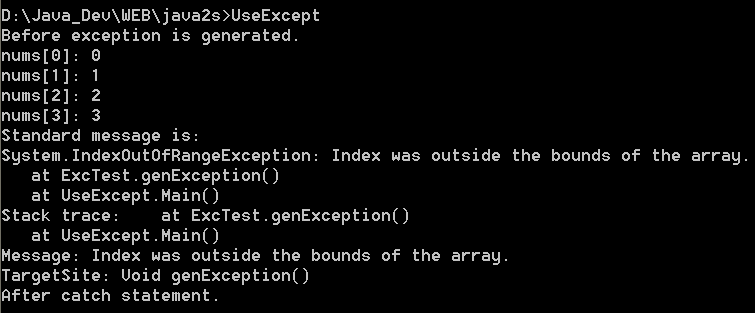
4. Using Exception membersUsing Exception members
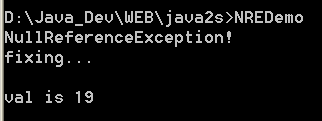
5. Use the NullReferenceExceptionUse the NullReferenceException
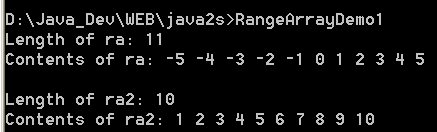
6. Use a custom Exception for RangeArray errorsUse a custom Exception for RangeArray errors
7. Derived exceptions must appear before base class exceptionsDerived exceptions must appear before base class exceptions
8. calls GetBaseException and outputs the error message of the initial exception.
9. uses some of the properties of the Exception class
10. Using checked and uncheckedUsing checked and unchecked
11. refines the System.Exception base class with name of the type and time of exception to create your own Exception
12. Using checked and unchecked with statement blocksUsing checked and unchecked with statement blocks
13. Exception Handling: The Exception Hierarchy 1
14. Exception Handling: The Exception Hierarchy 2
15. Exception Handling: The Exception Hierarchy 3
16. Exception Handling User-Defined Exception ClassesException Handling User-Defined Exception Classes
w_w__w__.___jav__a___2s.___c__o_m_ | Contact Us
Copyright 2003 - 08 Demo Source and Support. All rights reserved.
All other trademarks are property of their respective owners.