Separating GUI logic and business objects
// : c14:Separation.java
// Separating GUI logic and business objects.
// <applet code=Separation width=250 height=150></applet>
// From 'Thinking in Java, 3rd ed.' (c) Bruce Eckel 2002
// www.BruceEckel.com. See copyright notice in CopyRight.txt.

import java.awt.Container;
import java.awt.FlowLayout;
import java.awt.event.ActionEvent;
import java.awt.event.ActionListener;

import javax.swing.JApplet;
import javax.swing.JButton;
import javax.swing.JFrame;
import javax.swing.JLabel;
import javax.swing.JPanel;
import javax.swing.JTextField;
import javax.swing.event.DocumentEvent;
import javax.swing.event.DocumentListener;

class BusinessLogic {
  private int modifier;

  public BusinessLogic(int mod) {
    modifier = mod;
  }

  public void setModifier(int mod) {
    modifier = mod;
  }

  public int getModifier() {
    return modifier;
  }

  // Some business operations:
  public int calculation1(int arg) {
    return arg * modifier;
  }

  public int calculation2(int arg) {
    return arg + modifier;
  }
}

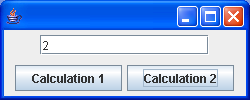
public class Separation extends JApplet {
  private JTextField t = new JTextField(15), mod = new JTextField(15);

  private JButton calc1 = new JButton("Calculation 1"), calc2 = new JButton(
      "Calculation 2");

  private BusinessLogic bl = new BusinessLogic(2);

  public static int getValue(JTextField tf) {
    try {
      return Integer.parseInt(tf.getText());
    } catch (NumberFormatException e) {
      return 0;
    }
  }

  class Calc1L implements ActionListener {
    public void actionPerformed(ActionEvent e) {
      t.setText(Integer.toString(bl.calculation1(getValue(t))));
    }
  }

  class Calc2L implements ActionListener {
    public void actionPerformed(ActionEvent e) {
      t.setText(Integer.toString(bl.calculation2(getValue(t))));
    }
  }

  // If you want something to happen whenever
  // a JTextField changes, add this listener:
  class ModL implements DocumentListener {
    public void changedUpdate(DocumentEvent e) {
    }

    public void insertUpdate(DocumentEvent e) {
      bl.setModifier(getValue(mod));
    }

    public void removeUpdate(DocumentEvent e) {
      bl.setModifier(getValue(mod));
    }
  }

  public void init() {
    Container cp = getContentPane();
    cp.setLayout(new FlowLayout());
    cp.add(t);
    calc1.addActionListener(new Calc1L());
    calc2.addActionListener(new Calc2L());
    JPanel p1 = new JPanel();
    p1.add(calc1);
    p1.add(calc2);
    cp.add(p1);
    mod.getDocument().addDocumentListener(new ModL());
    JPanel p2 = new JPanel();
    p2.add(new JLabel("Modifier:"));
    p2.add(mod);
    cp.add(p2);
  }

  public static void main(String[] args) {
    run(new Separation(), 250, 100);
  }

  public static void run(JApplet applet, int width, int height) {
    JFrame frame = new JFrame();
    frame.setDefaultCloseOperation(JFrame.EXIT_ON_CLOSE);
    frame.getContentPane().add(applet);
    frame.setSize(width, height);
    applet.init();
    applet.start();
    frame.setVisible(true);
  }
} ///:~
Related examples in the same category