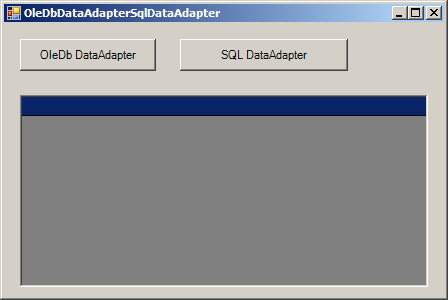
using System;
using System.Drawing;
using System.Collections;
using System.ComponentModel;
using System.Windows.Forms;
using System.Data;
using System.Data.SqlClient;
using System.Data.OleDb;

public class OleDbDataAdapterSqlDataAdapter : System.Windows.Forms.Form
{
  private System.Windows.Forms.Button OleDbDataAdapter;
  private System.Windows.Forms.Button SqlDataAdapter;
  private System.Windows.Forms.DataGrid dataGrid1;

  private System.ComponentModel.Container components = null;

  public OleDbDataAdapterSqlDataAdapter()
  {
    InitializeComponent();
  }

  protected override void Dispose( bool disposing )
  {
    if( disposing )
    {
      if (components != null)
      {
        components.Dispose();
      }
    }
    base.Dispose( disposing );
  }

  private void InitializeComponent()
  {
    this.OleDbDataAdapter = new System.Windows.Forms.Button();
    this.SqlDataAdapter = new System.Windows.Forms.Button();
    this.dataGrid1 = new System.Windows.Forms.DataGrid();
    ((System.ComponentModel.ISupportInitialize)(this.dataGrid1)).BeginInit();
    this.SuspendLayout();
    //
    // OleDbDataAdapter
    //
    this.OleDbDataAdapter.Location = new System.Drawing.Point(16, 16);
    this.OleDbDataAdapter.Name = "OleDbDataAdapter";
    this.OleDbDataAdapter.Size = new System.Drawing.Size(136, 32);
    this.OleDbDataAdapter.TabIndex = 0;
    this.OleDbDataAdapter.Text = "OleDb DataAdapter";
    this.OleDbDataAdapter.Click += new System.EventHandler(this.OleDbDataAdapter_Click);
    //
    // SqlDataAdapter
    //
    this.SqlDataAdapter.Location = new System.Drawing.Point(176, 16);
    this.SqlDataAdapter.Name = "SqlDataAdapter";
    this.SqlDataAdapter.Size = new System.Drawing.Size(168, 32);
    this.SqlDataAdapter.TabIndex = 1;
    this.SqlDataAdapter.Text = "SQL DataAdapter";
    this.SqlDataAdapter.Click += new System.EventHandler(this.SqlDataAdapter_Click);
    //
    // dataGrid1
    //
    this.dataGrid1.DataMember = "";
    this.dataGrid1.HeaderForeColor = System.Drawing.SystemColors.ControlText;
    this.dataGrid1.Location = new System.Drawing.Point(16, 72);
    this.dataGrid1.Name = "dataGrid1";
    this.dataGrid1.Size = new System.Drawing.Size(408, 192);
    this.dataGrid1.TabIndex = 2;
    //
    // OleDbDataAdapterSqlDataAdapter
    //
    this.AutoScaleBaseSize = new System.Drawing.Size(5, 13);
    this.ClientSize = new System.Drawing.Size(440, 273);
    this.Controls.AddRange(new System.Windows.Forms.Control[] {
                                    this.dataGrid1,
                                    this.SqlDataAdapter,
                                    this.OleDbDataAdapter});
    this.Name = "OleDbDataAdapterSqlDataAdapter";
    this.Text = "OleDbDataAdapterSqlDataAdapter";
    ((System.ComponentModel.ISupportInitialize)(this.dataGrid1)).EndInit();
    this.ResumeLayout(false);

  }

  [STAThread]
  static void Main()
  {
    Application.Run(new OleDbDataAdapterSqlDataAdapter());
  }

  private void OleDbDataAdapter_Click(object sender, System.EventArgs e)
    {
        string ConnectionString = @"Provider=Microsoft.Jet.OLEDB.4.0; Data Source=c:\Northwind.mdb";
        string SQL = "SELECT * FROM Customers";

        OleDbConnection conn = new OleDbConnection(ConnectionString);
        conn.Open();

        OleDbDataAdapter adapter = new OleDbDataAdapter();
        adapter.SelectCommand = new OleDbCommand(SQL, conn);

        DataSet ds = new DataSet("Customers");
        adapter.Fill(ds, "Customers");

    adapter.DeleteCommand = new OleDbCommand("DELETE * FROM Customers");

    adapter.Update(ds, "Customers");

    dataGrid1.DataSource = ds.DefaultViewManager;
    }

  private void SqlDataAdapter_Click(object sender, System.EventArgs e)
    {

        string ConnectionString ="Integrated Security=SSPI;" +
            "Initial Catalog=Northwind;" +
            "Data Source=localhost;";
        string SQL = "SELECT CustomerID, CompanyName FROM Customers";

        SqlConnection conn = new SqlConnection(ConnectionString);
        conn.Open();

        SqlDataAdapter adapter = new SqlDataAdapter(SQL, conn);

        DataSet ds = new DataSet("Customers");
        adapter.Fill(ds);

        dataGrid1.DataSource = ds.DefaultViewManager;
    }
}