Imports System.Windows.Forms

public class KeysCodeF5
   public Shared Sub Main
        Application.Run(New Form1)
   End Sub
End class


Public Class Form1
    Private Sub Form1_KeyDown(ByVal sender As Object, _
          ByVal e As System.Windows.Forms.KeyEventArgs) _
          Handles Me.KeyDown
        If (e.KeyCode = Keys.F5) Then Console.WriteLine("Form: F5")
        e.Handled = True
    End Sub

    Private Sub TextBox1_KeyDown(ByVal sender As Object, _
          ByVal e As System.Windows.Forms.KeyEventArgs) _
          Handles TextBox1.KeyDown
        If (e.KeyCode = Keys.F5) Then Console.WriteLine("Text: F5")
    End Sub
End Class


<Global.Microsoft.VisualBasic.CompilerServices.DesignerGenerated()> _
Partial Class Form1
    Inherits System.Windows.Forms.Form

    'Form overrides dispose to clean up the component list.
    <System.Diagnostics.DebuggerNonUserCode()> _
    Protected Overrides Sub Dispose(ByVal disposing As Boolean)
        If disposing AndAlso components IsNot Nothing Then
            components.Dispose()
        End If
        MyBase.Dispose(disposing)
    End Sub

    'Required by the Windows Form Designer
    Private components As System.ComponentModel.IContainer

    'NOTE: The following procedure is required by the Windows Form Designer
    'It can be modified using the Windows Form Designer.
    'Do not modify it using the code editor.
    <System.Diagnostics.DebuggerStepThrough()> _
    Private Sub InitializeComponent()
        Me.TextBox1 = New System.Windows.Forms.TextBox
        Me.SuspendLayout()
        '
        'TextBox1
        '
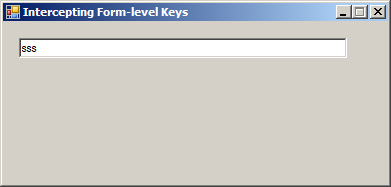
        Me.TextBox1.Location = New System.Drawing.Point(16, 16)
        Me.TextBox1.Name = "TextBox1"
        Me.TextBox1.Size = New System.Drawing.Size(328, 20)
        Me.TextBox1.TabIndex = 0
        '
        'Form1
        '
        Me.AutoScaleDimensions = New System.Drawing.SizeF(6.0!, 13.0!)
        Me.AutoScaleMode = System.Windows.Forms.AutoScaleMode.Font
        Me.ClientSize = New System.Drawing.Size(385, 162)
        Me.Controls.Add(Me.TextBox1)
        Me.FormBorderStyle = System.Windows.Forms.FormBorderStyle.FixedSingle
        Me.KeyPreview = True
        Me.MaximizeBox = False
        Me.Name = "Form1"
        Me.Text = "Intercepting Form-level Keys"
        Me.ResumeLayout(False)
        Me.PerformLayout()

    End Sub
    Friend WithEvents TextBox1 As System.Windows.Forms.TextBox

End Class