Java Tutorial - Java Boolean Operator
The Boolean logical operators operate on boolean operands.
Logical Operator List
The following table lists all Java boolean logical operators.
| Operator | Result |
|---|---|
| & | Logical AND |
| | | Logical OR |
| ^ | Logical XOR (exclusive OR) |
| || | Short-circuit OR |
| && | Short-circuit AND |
| ! | Logical unary NOT |
| &= | AND assignment |
| |= | OR assignment |
| ^= | XOR assignment |
| == | Equal to |
| != | Not equal to |
| ? : | Ternary if-then-else |
True table
The following table shows the effect of each logical operation:
| A | B | A | B | A & B | A ^ B | !A |
|---|---|---|---|---|---|
| False | False | False | False | False | True |
| True | False | True | False | True | False |
| False | True | True | False | True | True |
| True | True | True | True | False | False |
The following program demonstrates the boolean logical operators.
public class Main {
  public static void main(String args[]) {
    boolean a = true;
    boolean b = false;
    boolean c = a | b;
    boolean d = a & b;
    boolean e = a ^ b;
    boolean f = (!a & b) | (a & !b);
    boolean g = !a;
    System.out.println(" a = " + a);
    System.out.println(" b = " + b);
    System.out.println(" a|b = " + c);
    System.out.println(" a&b = " + d);
    System.out.println(" a^b = " + e);
    System.out.println("!a&b|a&!b = " + f);
    System.out.println(" !a = " + g);
//  www  .  j  a v  a2  s.c om
  }
}
]]>
The output:
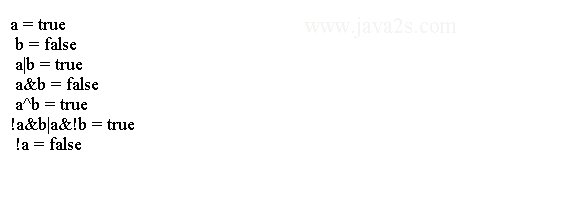
Example
The following program demonstrates the bitwise logical operators:
public class Main {
  public static void main(String args[]) {
    int a = 1;//from  w w  w . j av  a2 s. c o  m
    int b = 2;
    int c = a | b;
    int d = a & b;
    int e = a ^ b;
    int f = (~a & b) | (a & ~b);
    int g = ~a & 0x0f;
    System.out.println(" a = " + a);
    System.out.println(" b = " + b);
    System.out.println(" a|b = " + c);
    System.out.println(" a&b = " + d);
    System.out.println(" a^b = " + e);
    System.out.println("~a&b|a&~b = " + f);
    System.out.println(" ~a = " + g);
  }
}
Here is the output from this program:
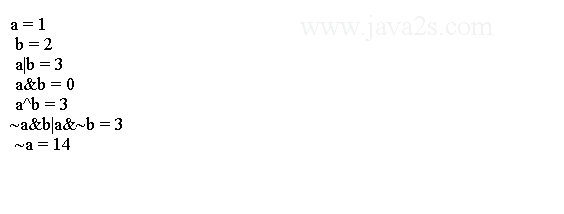
Java Logical Operators Shortcut
The OR operator results in true when one operand is true,
no matter what the second operand is.
The AND operator results in false when one operand is false, no matter what the second
operand is.
If you use the || and &&, Java will not evaluate the right-hand
operand when the outcome
can be determined by the left operand alone.
The following code shows how you can use short-circuit logical operator to ensure that a division operation will be valid before evaluating it:
public class Main {
  public static void main(String[] argv) {
    int denom = 0;
    int num = 3;// ww  w .  j  a v  a  2s  .  c  om
    if (denom != 0 && num / denom > 10) {
      System.out.println("Here");
    } else {
      System.out.println("There");
    }
  }
}
The output:

If we want to turn of the shortcut behaviour of logical operators we can use & and |.
Example 2
The following code uses a single & ensures that the increment operation will
be applied to e whether c is equal to 1 or not.
public class Main {
  public static void main(String[] argv) {
    int c = 0;/*  www  .j  a  va2 s. c om*/
    int e = 99;
    int d = 0;
    if (c == 1 & e++ < 100)
      d = 100;
    System.out.println("e is " + e);
    System.out.println("d is " + d);
  }
}
The output:
