Store Objects in Collection and retrieve
Imports System
Imports System.Collections

Public Class MainClass

    Shared Sub Main()
       Dim intCollection As New Collection(  )
       Dim empCollection As New Collection(  )
       Dim empCollection2 As New Collection(  )

       'populate the Collections
       Dim i As Integer
       For i = 0 To 4
           empCollection.Add(New Employee(i + 100))
           intCollection.Add((i * 5))
       Next i

       'add key/value pairs
       empCollection2.Add(New Employee(1989), "G W")
       empCollection2.Add(New Employee(1997), "J A")
       empCollection2.Add(New Employee(1901), "T J")


       'print each member of the array
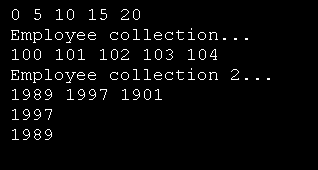
       For Each i In intCollection
           Console.Write("{0} ", i.ToString(  ))
       Next i

       Console.WriteLine(  )
       Console.WriteLine("Employee collection...")
       Dim e As Employee
       For Each e In empCollection
           Console.Write("{0} ", e.ToString(  ))
       Next e

       Console.WriteLine(  )
       Console.WriteLine("Employee collection 2...")
       For Each e In empCollection2
           Console.Write("{0} ", e.ToString(  ))
       Next e

       Console.WriteLine(  )

       'retrieve an Employee by key
       Dim emp As Employee
       emp = empCollection2.Item("J A")
       Console.WriteLine( emp.ToString(  ))

       'note that indexing is 1-based (rather than zero based)
       emp = empCollection2.Item(1)
       Console.WriteLine(emp.ToString(  ))
   End Sub

End Class

     Public Class Employee
         Private myEmpID As Integer

         Public Sub New(ByVal empID As Integer)
             Me.myEmpID = empID
         End Sub 'New

         Public Overrides Function ToString(  ) As String
             Return myEmpID.ToString(  )
         End Function 'ToString

         Public Property EmpID(  ) As Integer
             Get
                 Return myEmpID
             End Get
             Set(ByVal Value As Integer)
                 myEmpID = Value
             End Set
         End Property
     End Class 'Employee
Related examples in the same category