Scroll Form : Form « GUI Windows Forms « C# / CSharp Tutorial

C# / CSharp Tutorial
1. Language Basics
2. Data Type
3. Operator
4. Statement
5. String
6. struct
7. Class
8. Operator Overload
9. delegate
10. Attribute
11. Data Structure
12. Assembly
13. Date Time
14. Development
15. File Directory Stream
16. Preprocessing Directives
17. Regular Expression
18. Generic
19. Reflection
20. Thread
21. I18N Internationalization
22. GUI Windows Forms
23. 2D
24. Design Patterns
25. Windows
26. XML
27. ADO.Net
28. Network
29. Directory Services
30. Security
31. unsafe
Java
Java Tutorial
Java Source Code / Java Documentation
Java Open Source
Jar File Download
Java Articles
Java Products
Java by API
C# / C Sharp
ASP.Net
JavaScript DHTML
JavaScript Tutorial
JavaScript Reference
HTML / CSS
HTML CSS Reference
C / ANSI-C
C Tutorial
C++
C++ Tutorial
PHP
Python
SQL Server / T-SQL
SQL Server / T-SQL Tutorial
Oracle PL / SQL
Oracle PL/SQL Tutorial
PostgreSQL
SQL / MySQL
MySQL Tutorial
VB.Net
VB.Net Tutorial
Flash / Flex / ActionScript
VBA / Excel / Access / Word
Microsoft Office PowerPoint 2007 Tutorial
Microsoft Office Excel 2007 Tutorial
Microsoft Office Word 2007 Tutorial
C# / CSharp Tutorial » GUI Windows Forms » Form 
22. 2. 17. Scroll Form
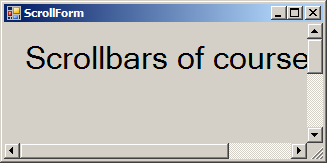
Scroll Form
using System;
using System.Drawing;
using System.Collections;
using System.ComponentModel;
using System.Windows.Forms;
using System.Data;

public class ScrollForm : System.Windows.Forms.Form
{
  private System.Windows.Forms.Label label1;
  private System.ComponentModel.Container components = null;

  public ScrollForm()
  {
    InitializeComponent();
  }
  protected override void Disposebool disposing )
  {
    ifdisposing )
    {
      if (components != null
      {
        components.Dispose();
      }
    }
    base.Disposedisposing );
  }

  private void InitializeComponent()
  {
    this.label1 = new System.Windows.Forms.Label();
    this.SuspendLayout();

    this.label1.Font = new System.Drawing.Font("Microsoft Sans Serif"24F);
    this.label1.Location = new System.Drawing.Point(1616);
    this.label1.Name = "label1";
    this.label1.Size = new System.Drawing.Size(376224);
    this.label1.TabIndex = 0;
    this.label1.Text = "Scrollbars of course!";

    this.AutoScaleBaseSize = new System.Drawing.Size(513);
    this.AutoScroll = true;
    this.AutoScrollMinSize = new System.Drawing.Size(300300);
    this.ClientSize = new System.Drawing.Size(319136);
    this.Controls.Add(this.label1);
    this.Name = "ScrollForm";
    this.Text = "ScrollForm";
    this.ResumeLayout(false);

  }

  [STAThread]
  static void Main() 
  {
    Application.Run(new ScrollForm());
  }
}
22. 2. Form
22. 2. 1. Subclass Form
22. 2. 2. Use Inherited form in a separate Main class
22. 2. 3. Inherit Form With Constructor
22. 2. 4. ResumeLayout and SuspendLayout
22. 2. 5. Call form constructor to create a Form object
22. 2. 6. Cal Show method to display a form
22. 2. 7. Text as the title
22. 2. 8. Set Form Visible properties
22. 2. 9. The difference between Form.Show and Application.Run()
22. 2. 10. The Hello, WindowsForms Application
22. 2. 11. Build Form without by hand
22. 2. 12. Inherited Form
22. 2. 13. Move a Form in codeMove a Form in code
22. 2. 14. Irregular formIrregular form
22. 2. 15. Add a Main Menu
22. 2. 16. Change Form size in menu action
22. 2. 17. Scroll FormScroll Form
22. 2. 18. Form message filter
22. 2. 19. Form Dispose
22. 2. 20. Change Form Cursor
22. 2. 21. Add control to Form dynamically
w__w___w__.__j_a_va__2_s___.__c___o_m__ | Contact Us
Copyright 2003 - 08 Demo Source and Support. All rights reserved.
All other trademarks are property of their respective owners.