Set form forground color : Control « GUI Windows Forms « C# / CSharp Tutorial

C# / CSharp Tutorial
1. Language Basics
2. Data Type
3. Operator
4. Statement
5. String
6. struct
7. Class
8. Operator Overload
9. delegate
10. Attribute
11. Data Structure
12. Assembly
13. Date Time
14. Development
15. File Directory Stream
16. Preprocessing Directives
17. Regular Expression
18. Generic
19. Reflection
20. Thread
21. I18N Internationalization
22. GUI Windows Forms
23. 2D
24. Design Patterns
25. Windows
26. XML
27. ADO.Net
28. Network
29. Directory Services
30. Security
31. unsafe
Java
Java Tutorial
Java Source Code / Java Documentation
Java Open Source
Jar File Download
Java Articles
Java Products
Java by API
C# / C Sharp
ASP.Net
JavaScript DHTML
JavaScript Tutorial
JavaScript Reference
HTML / CSS
HTML CSS Reference
C / ANSI-C
C Tutorial
C++
C++ Tutorial
PHP
Python
SQL Server / T-SQL
SQL Server / T-SQL Tutorial
Oracle PL / SQL
Oracle PL/SQL Tutorial
PostgreSQL
SQL / MySQL
MySQL Tutorial
VB.Net
VB.Net Tutorial
Flash / Flex / ActionScript
VBA / Excel / Access / Word
Microsoft Office PowerPoint 2007 Tutorial
Microsoft Office Excel 2007 Tutorial
Microsoft Office Word 2007 Tutorial
C# / CSharp Tutorial » GUI Windows Forms » Control 
22. 53. 9. Set form forground color
Set form forground color
using System;
using System.Windows.Forms;
using System.Drawing;

public class FormForegroundColorSetting : System.Windows.Forms.Form
{
  private System.Windows.Forms.Button button1;
  private System.Windows.Forms.TextBox textBox1;

  public FormForegroundColorSetting()
  {
    Text = "Test WinForm";

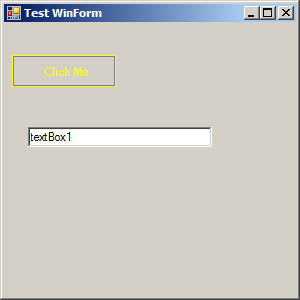
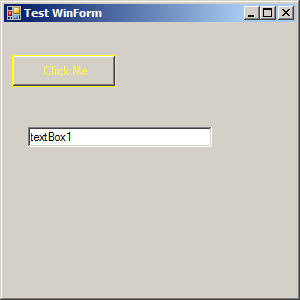
    ForeColor = System.Drawing.Color.Yellow;

    button1 = new System.Windows.Forms.Button();
    textBox1 = new System.Windows.Forms.TextBox();

    // button control and its properties
    button1.Location = new System.Drawing.Point(832);
    button1.Name = "button1";
    button1.Size = new System.Drawing.Size(10432);
    button1.TabIndex = 0;
    button1.Text = "Click Me";
        
    // text box control and its properties
    textBox1.Location = new System.Drawing.Point(24104);
    textBox1.Name = "textBox1";
    textBox1.Size = new System.Drawing.Size(18420);
    textBox1.TabIndex = 1;
    textBox1.Text = "textBox1";
        
    // Adding controls to the fomr
    Controls.AddRange(new System.Windows.Forms.Control[]{textBox1, button1} );

    button1.Click += new System.EventHandler(button1_Click);
                    
  }

  private void button1_Click(object sender,System.EventArgs e)
  {
    textBox1.Text = "Button is clicked";
    MessageBox.Show("Button is clicked");
  }

  public static int Main()
  {
    Application.Run(new FormForegroundColorSetting());
    return 0;
  }       
}
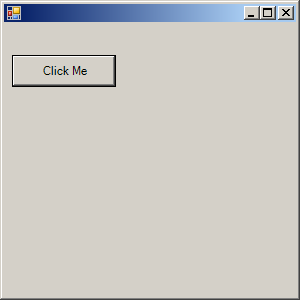
22. 53. Control
22. 53. 1. Control: TabIndex, Size and LocationControl: TabIndex, Size and Location
22. 53. 2. Control Tag PropertyControl Tag Property
22. 53. 3. Control Size and Location - DynamicControl Size and Location - Dynamic
22. 53. 4. Control Size and LocationControl Size and Location
22. 53. 5. Override the DefaultSize property to gain better performance
22. 53. 6. Create User Control based on Control classCreate User Control based on Control class
22. 53. 7. Get controls on a form and verify its typeGet controls on a form and verify its type
22. 53. 8. Set Caption(title) of the formSet Caption(title) of the form
22. 53. 9. Set form forground colorSet form forground color
22. 53. 10. Render onto the buttonRender onto the button
w_ww___.__j___a__v_a2s___.co_m_ | Contact Us
Copyright 2003 - 08 Demo Source and Support. All rights reserved.
All other trademarks are property of their respective owners.